Wednesday, September 27, 2006

Photophilia


These are two Kodacolor™ films I found in a local camera shop today. they expired in 1983 so I doubt I'll try them.
The reason I'm going to keep them is mainly nostalgic as I started my photographic career when these films were the current emulsion, and C41 was the new process (previously C22)
Inside the box was the original leaflet, please note the exposure info, as mentioned in my previous post 'guessing exposures'

Also of interest is the 'cutting guide' template for Leica thread mount cameras, and this may be useful for some of you LTM users: there is a link to the full size image 'here'
It may be possible for you to save the image (right click Windows just drag to the desktop Mac) then print the template in Photoshop.

Tuesday, September 26, 2006

Mechanical Manual Cameras


The Nikon F2.

The little collection above is my 1977 Nikon F2 in a Nikon case. The case has room for 3 lenses in a chrome F mount keeper and a flash (where I keep my spotmeter).
The F2 was the sucessor the the F, and is a tough manual camera that needs no battery with the plain DP1 finder but when used with metered finders needs power to operate the meter only.
As you can see the F2 is a rugged workhorse, I'd hate to think how many films have been though it, but I have no doubts about it's reliability.
I have some pretty good lenses with my Nikons, the 28mm F3.5 Nikkor-HC 50mm F2 (superb) 85mm F2 (good and sharp) and the 105mm F2.5 (excellent)
These cameras are available for peanuts now, but at the time I started photography were the de-facto tool for most Pro's. So if you want to try a no batteries manual film camera, an F2 would be a great bargain!

Monday, September 25, 2006

An Un-acceptable Pastime?

Most days I carry a camera with me, normally my M4P. Today was no exception, even though the rain was falling out of the sky I decided to put it in my back-pack (I cycle to work).
It rained all day, and for those of you who know the UK it was a grey, dull day; no photographic inspiration.
But on the way home I spotted something I found amusing, someone's jacket had got so wet they'd just put it in the bin.
Not a great picture but worth a go, so out came my spot-meter and camera, took some readings-urgh 60th at F2.8.
Just as I was about to transfer the settings to the camera I felt a tap on my shoulder, and as I turned a guy prodded me in the chest ' have you taken any photos of me', startled I just replied 'no' 'you better not you *unt', he replied.
Not wanting any confrontation I just tuned my back and took 3-4 shots of the bin not wanting to turn round, and hopped on my bike and went on my way.
After I arrived home I spoke to my wife about the incident, she was pretty shocked but suggested I leave my camera at home or only shoot landscapes and the kids.

I'm not going to stop shooting in the towns; but one thing I have noticed, photographing public places is no longer acceptable to the general public. Twenty years ago what was considered to many to be a harmless hobby is now viewed with distrust and disdain, indeed most think you are acting illegally when you shoot a street scene.

It saddens me that i now have to look over my shoulder and it could be that someday someone will take it upon himself to stop my 'anti-social behaviour'.

So I'm a bit down today and there will be no images in this post

Saturday, September 23, 2006

The Light Fantastic

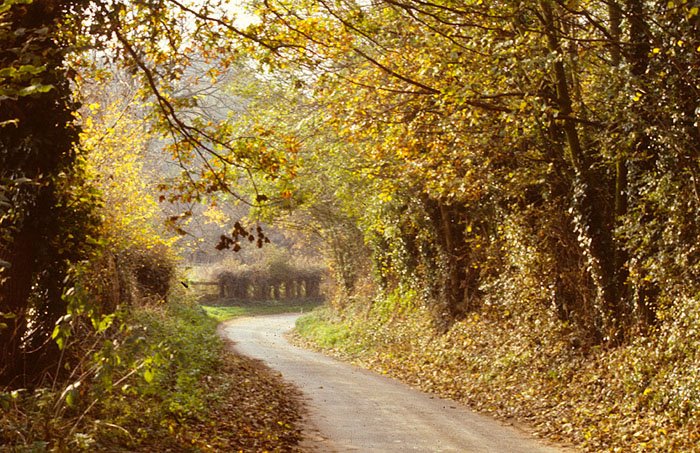
Autumn light, soft warm and perfect for the colours of the dying trees.


This time of year has to be one of my favourite for colour photography. Early morning mist and dew covers the leaves, flowers and cobwebs perfect subjects for close focus and macro work.(Kodachromes in the mail)
The longer more dramatic shadows and the yellow light make great subjects also.

One of the best photographic lessons anyone ever taught me, was when a friend of my father gave me a roll of Ektachrome 64.
He had one proviso: 'use this roll of film to take a picture of your favourite scene every day for the next month.'
I thought he was crazy, won't it get boring? who would want to see 30 shots of the same thing?
The month was October, my chosen scene was a local ruined church almost obscured by trees, I had to shoot it when I could, and this often worked out at different times of the day.
He processed the transparencies for me and put them into clear sleeves, he then showed them to me on his portable light-box.
I was actually pretty surprised, when I surveyed the film in front of me, every single image was different. Different colours, saturation, some were yellow a couple looked blue/cyan.

But the lesson it taught me as we never just photograph a subject, but rather the light falling on that subject and here in the UK the light often changes by the hour:- so if you see an interesting scene photograph it.

After all it may be a unique moment in time.

Thursday, September 21, 2006

A Months Wages


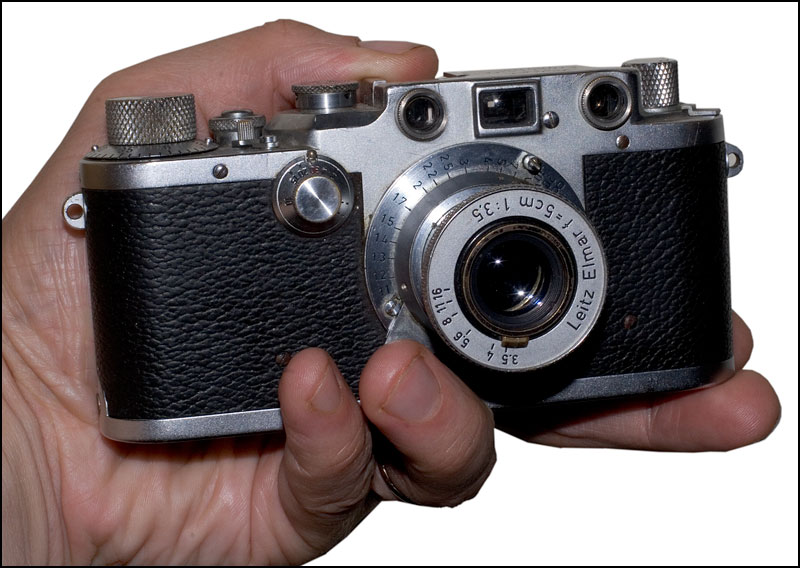
That was the cost of my first Leica, a 111c model made in 1947 and with it I purchased a Elmar 50mm F3:5.
Why did I make this insane purchase? I mean why buy what was at the time a 39 year old camera?

I had recently been to an exhibition of photographs by Henri Cartier-Bresson with a photographer friend of mine.

I really loved the immediacy and closeness of his pictures coupled with the feeling of being an observer.

It was the type of work that the miniature format Leica excelled at, being able to take shots unobserved: with the subject showing no or little reaction to having their image captured.
That must have proved very difficult in the days when cameras were not commonplace on the streets of our cities.
At the time I was shooting with a mixture of Pro Canon and Nikon models none of which really are for secretive picture taking, not just because of physical size but also mirror noise.

After using the little camera I found that I had underestimated one thing- the optics.
The 50mm F3.5 Elmar was very similar to the original design first computed by Max Berek in 1924 but with one important change- Lens coatings.

After the initial shock at how sharp the Elmar was, I decided to test it against my two Nikon 50mm lenses a 1.8 and a Nikkor H F2.
I was amazed that looking at the different lenses that there was very little between them once you got to F5.6 with the Leica having marginally better deffinition in the centre at F8 and the Nikor F2 the best at the edge.

The camera has served me well in the 20 years I've owned it, in fact I've never owned a camera for longer.
So was it worth it? You bet!
Guessing Exposures With Manual Cameras

The Sunny Sixteen Method

My Leica 111c left the Wetzlar factory in 1947, at the time very few (if any) cameras had built in light-meters, so my main problem was how to meter.
At the time I hadn't enough cash to buy a hand-held meter, so my options were to drag around my Nikkormat to meter with or just use my experience to make an educated guess.

I decided on the latter; but how educated could my guess be?
The system I decided on was the 'Sunny Sixteen' and it works very well, particuarly with negative film.

The Method is as follows:

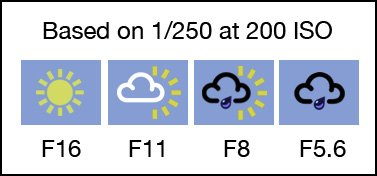
First you choose the nearest shutter speed to match your film speed say 1/125 if you are using 100 ISO.
Then your aperture value will be set according to the light/weather conditions:

Sunny F16 (hard shadows)

Sun/Cloud F11 (soft shadows)

Cloudy F8 (barely visible shadows)

Overcast/Dull F5.6 (no shadows)

In bygone days the film manufacturers used to print his info with nice graphical representation inside the box, and this could be taped to the back of your camera.

My hand-held light meter


Most of the photographers I know don't even own one of these beasts, probably wouldn't know how to use one if given one, or just rely on their built in camera meters.
That's fine, especially with modern SLRs both film and digital; in fact DSLR users may choose to rely mainly on their histogram info.

But that's not very practical for me, none of my film cameras have built in light meters as I favour totally manual operation.
For people using manual meterless cameras (like my Leica M4-P) only have 2 choices, either guess (using the sunny 16 method) or buy an external or hand held light meter.
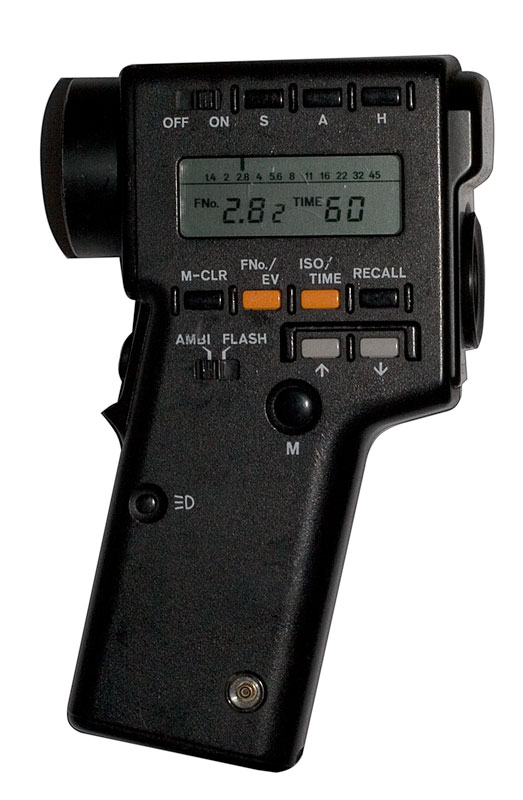
My choice was the Minolta Spotmeter F.

The Spotmeter has a 1% angle of sensitivity that makes it perfect for the Zone System which is a very accurate way of controlling tones recorded on B&W film.


The meter reading is taken from the tiny circle in the centre

Monday, September 18, 2006


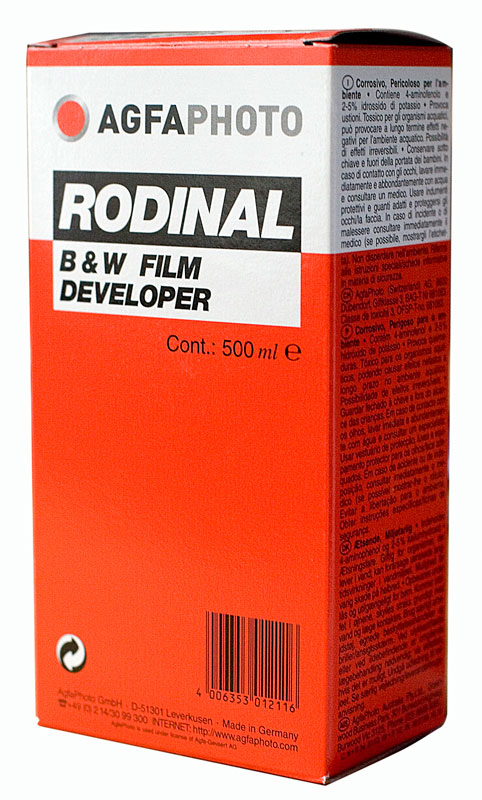
Rodinal


Agfa Rodinal has been in production for over 100 years, and despite rumours to the contrary, it is still produced and available today.
Rodinal is a unique product in quite a few ways, it has excellent keeping properties (many years in a stoppered bottle) and can be diluted for both economy and its 'compensating' effect.
I use it to tame excessive contrast in subjects, especially on very bright sunny days, where the range of tones in the subject exceeds the tones the film can handle.
I have found certain films such as Ilford Pan F Kodak Plus-X and Fuji Acros in particular to have far too much contrast at recommended developing times.
One often quoted property of Rodinal is that it increases the grain of the film, that isn't true. At the 1:25 dilution the developer will give you very similar results to any general purpose developer in both apparent grain and acutance, higher dilutions will show progessively more grain along with increased accutance.
That doesn't mean (as I've heared people suggest) that Rodinal gives 'huge grain' but defined rather than smooth.
It must be said that some will feel that films need downrating to a lower EI and for some films that may be true I personally rate Kodak TMX at EI64 and HP5+ at EI320 to give the shadow detail I require.
Here is a shot taken on my Rollei TLR using HP5+ which was then developed in Rodinal at 1:100 dilution (5ml developer in 495ml water)
click on the image to see a larger view.

The image is typical of what a photographer can expect from highly diluted Rodinal; smooth tonal range, high acutance (aparent sharpness of fine detail) and slight compensating effect helping compress specular highlights with a small loss of photographic speed.
But what about grain? where is the grainy mess promised to us by internet experts?I know, this is medium format, where grain doesn't show as much but looking at prints from Rodinal negatives grain is rarely the problem most would lead you to believe.
Here is a 100 percent crop.


I'm not suggesting Rodinal is a panacea or wonder developer just that it is a valuable tool in my darkroom
All images and text © Mark Antony Smith

Thursday, September 14, 2006

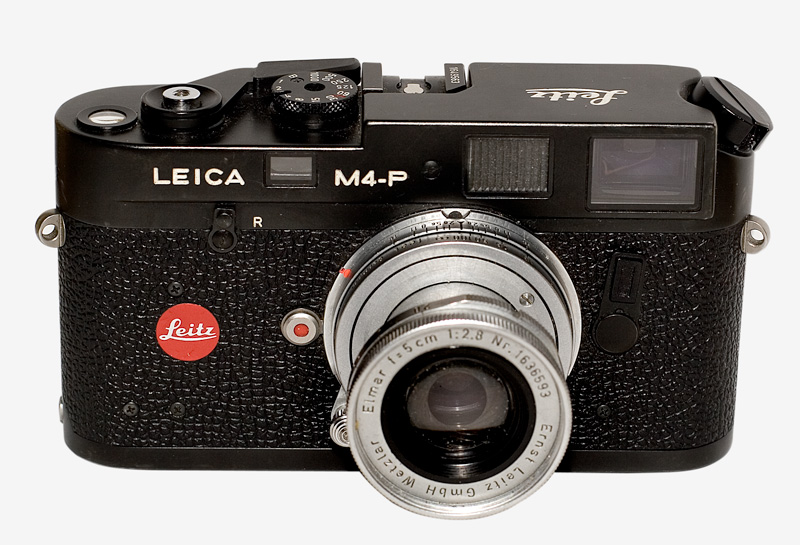
My Leica


What makes Leica special?

The Leica was the first practical miniature format camera. Invented by Oskar Barnack in order to take pictures while on his mountain walks.
It actually didn't go into production until over ten years after Barnacks 1913 prototype 'UR-Leica'.
But it's diminutive size and high mechanical and optical quality saw it adopted by many photographers for the new ''repotage'' style, to which the camera leant itself to perfectly.
Many other companies have copied the Leica but none have remained as faithful to the original design idea.
In fact Leica announced just yesterday their new digital rangefinder the M8.
Most people would ask what's the fuss? Why would anyone want a manual focus rangefider digi-cam?
Simple, the Leica remains an original; mechanically and optically equalled but never surpassed, something to aspire to, but most of all it is a joy to use and own.
Monochrome


Early Days
I think most of the best images I've made have been in Black and White.
Personally I feel the colour in some photos can become obstructive in the putting across of what I want to say with my images.

The first photo I took was on Ilford FP4, I exposed, processed and printed it all within a few hours of buying my first camera. Athough now I look back in mild amusement at my early attemtps at the art of photography, those early days of processing my own photos have pretty much driven my desire to perfect my work since.

My first darkroom consisted of a Patterson System 4 Film Tank (which I still own) a Krokus 35mm Enlarger (Polish I think) a safelight and 3 trays.

The chemicals I used were mostly Ilford and my first papers were Kodak Royal Bromesko and Agfa Record Rapid, both lovely papers.

When I look back at my first attempts at printing, I look at the grey dull low contast prints that were 'pulled' out of the developer far too early (they looked OK under red safelight) with a smile.

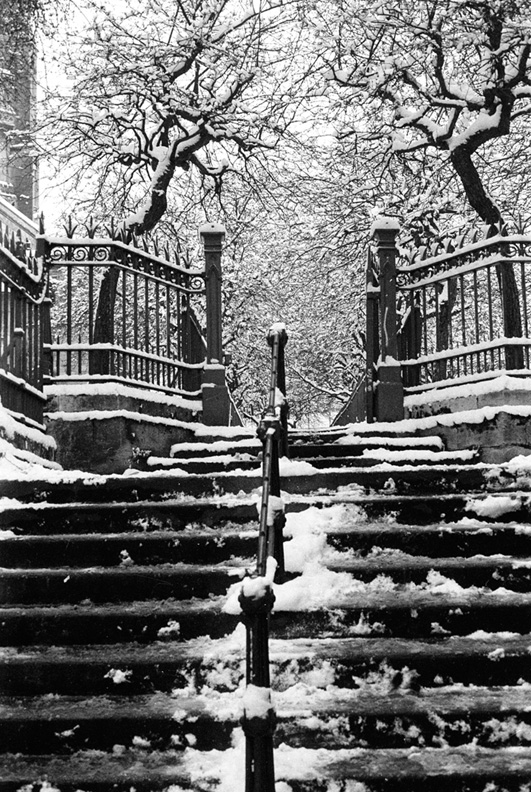
The picture above was an early photo of mine, taken on FP4 with a 50mm lens (the only lens I owned at the time)

Wednesday, September 13, 2006

Kodachrome


This film has been around since the mid 1930's and for me defines colour photography in the 20th Century.
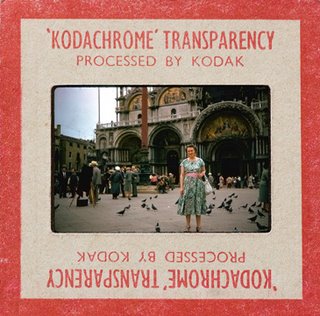
The image above was taken in the 1950's and is over 50 years old, but still it looks as fresh as the day it was made. No other colour film has the archival qualities of Kodachrome and I believe that also extends to the realm of the digital image.

I came across the slide above in a local second-hand camera shop and have no idea who the lady is in picture, just that this is part of a Italian holiday she and her husband enjoyed before I was born!
The films speed at the time was around 10 ASA (compared to 64 today) so anything but good lighting conditions was a challenge.

Why do I still use this antiquated product?
Simple- it gives good colours, fine grain and has a high sharpness. Other films also posses these qualities but none has the longevity. The slides I take of my children today will be easily accessible long after my death by simply holding them up to the light (try that with a DVD). I doubt a fraction of my digital images will survive, I know for sure I've lost one or two from as little as seven years ago due to CD failure.
So I'm preserving the family memories in the best possible way:-
A Leica loaded with Kodachrome

Kids on beach 2006
Long live Kodachrome!

Friday, August 11, 2006


As the inexorable march of digital technology penetrates deeper into the world of photography, why are there still proponents of the 'old way' what makes film so special?

This blog will mainly concentrate on my love affair with the photographic image captured on silver.

Why "Photo Utopia?" I hear you ask.

Utopia is an unrealistic goal for society as outlined in the book 'Utopia" by Sir Thomas Moore in the 16th Century, and is such has a double meaning which is derived from two Greek words: Eutopia (meaning 'good place') and Outopia (meaning 'no place')
The common English language usage is:

"The word UTOPIA stands in common usage for the ultimate in human folly or human hope – vain dreams of perfection in our lives.

Hence with "Photo Utopia" being the struggle for Photographic perfection, as a photo is a facsimile of reality this is an unobtainable goal.
But I have fun trying!

All text and images © Mark Antony Smith 2006