Showing posts with label Agfa. Show all posts

Friday, August 03, 2007

Last of the 1940s film


Simply beautiful

This is the second roll, much better than the first with less fogging. One thing is for sure this guy was a very good photographer!
more later...

© Mark Antony Smith

Tuesday, July 10, 2007

Agfa Ultra-Speed

If you read this blog regularly you'll know that recently I found a roll of Agfa-Speed Ultra on Ebay. The film is a little out of date.... well it actually expired in 1941 which makes it ancient history film-wise.
It was made by Agfa-Ansco in America, Binghamton N.Y to be exact, and according to my google seaches had a Weston speed of around 80.

Here are a few photos:

Above is the Warranty and Warning
Next a rear view of the tin showing the Agfa logo

Lastly a side view.

I shall atempt to use the film in my Leica with vintage Elmars both 50 & 90 mm, I doubt anthything will come out as the film will probably be fogged, but it will be fun (and it's a lovely old tin even if the film is Kaput).

If anyone has any more information about this film, such as a confirmation of film speed or even development time suggestions for Rodinal, it would be most welcome.

Wednesday, May 23, 2007

Agfapan 400


Another film from the now defunct Agfa. The Agfapan range of films were hugely underated in my opinion, and APX400 probably suffered in that respect more than the rest of the range, living in the shadow of both Tri-X and HP5.


'Wensum Emporium' APX 400 at 1:50 18 mins in Rodinal (Duotone Record Rapid effect)
Personally I feel that's a shame, as it has the wonderful tonal range of the rest of the Agfapan films, with a lovely grain structure and accutance which compares favourably with Tri-x, and to me is preferable to HP5.

Below is a 100% crop of to show the grain pattern:


After Processing the film has a grey base colour, this is normal not due to base fog or poorly stored film, and although it prints/scans well, it may look strange if your normal film is something like Neopan.

It really is a shame about the demise of Agfa. I nearly didn't bother testing their films, but they are just SO good! If I hadn't given them at least a mention it would have been unfair as they are still available though many retailers.
When the current batch are gone one of the truly great photographic emulsions will be history.
So one to try out of curiosity but not a long term prospect.

All images and text © Mark Smith 2007

Monday, September 18, 2006


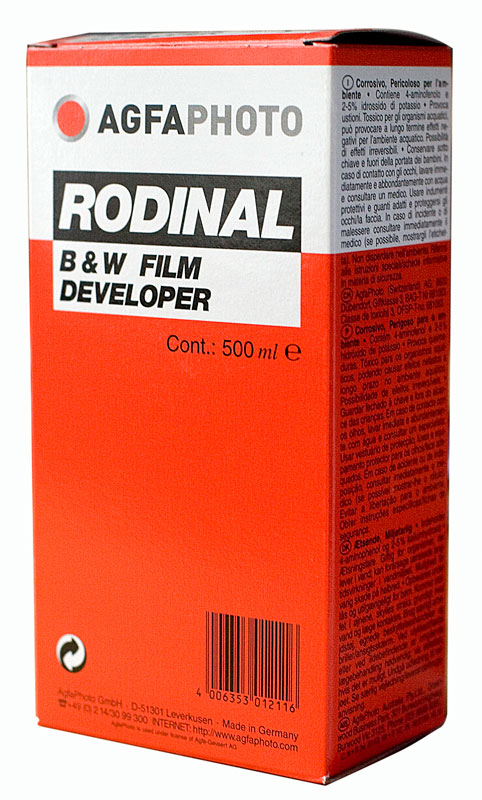
Rodinal


Agfa Rodinal has been in production for over 100 years, and despite rumours to the contrary, it is still produced and available today.
Rodinal is a unique product in quite a few ways, it has excellent keeping properties (many years in a stoppered bottle) and can be diluted for both economy and its 'compensating' effect.
I use it to tame excessive contrast in subjects, especially on very bright sunny days, where the range of tones in the subject exceeds the tones the film can handle.
I have found certain films such as Ilford Pan F Kodak Plus-X and Fuji Acros in particular to have far too much contrast at recommended developing times.
One often quoted property of Rodinal is that it increases the grain of the film, that isn't true. At the 1:25 dilution the developer will give you very similar results to any general purpose developer in both apparent grain and acutance, higher dilutions will show progessively more grain along with increased accutance.
That doesn't mean (as I've heared people suggest) that Rodinal gives 'huge grain' but defined rather than smooth.
It must be said that some will feel that films need downrating to a lower EI and for some films that may be true I personally rate Kodak TMX at EI64 and HP5+ at EI320 to give the shadow detail I require.
Here is a shot taken on my Rollei TLR using HP5+ which was then developed in Rodinal at 1:100 dilution (5ml developer in 495ml water)
click on the image to see a larger view.

The image is typical of what a photographer can expect from highly diluted Rodinal; smooth tonal range, high acutance (aparent sharpness of fine detail) and slight compensating effect helping compress specular highlights with a small loss of photographic speed.
But what about grain? where is the grainy mess promised to us by internet experts?I know, this is medium format, where grain doesn't show as much but looking at prints from Rodinal negatives grain is rarely the problem most would lead you to believe.
Here is a 100 percent crop.


I'm not suggesting Rodinal is a panacea or wonder developer just that it is a valuable tool in my darkroom
All images and text © Mark Antony Smith