Showing posts with label Kodachrome. Show all posts

Monday, May 25, 2015

Forgotten Pioneers of colour photography


Ask most photographers about early colour photography and they'll probably mention Kodachrome, some might point to the Autochrome process from the early part of the 20th Century but most will be un-aware of the work of one of the colour pioneers Louis Arthur Ducos du Hauron.

Ducos du Hauron worked on the theory of colour photography in the early 1860's writing papers and publishing a book Les couleurs en photographie, solution du problème in 1869.
To start with most of his work was purely theroretical because the photographic emulsions of the time were blue sensitive only and Ducos du Hauron's process required three exposures with different colour filters placed over the camera lens; one green one orange and one violet.
So for the moment the process was purely theory as the materials needed (film sensitive to green and yellow/red) didn't exist.

Then in 1873 a German scientist called Herman Willhelm Vogel made a discovery that would change photography forever. He discovered that the addition of a dye called Corallin when mixed with a standard emulsion extended the sensitivity into the green and yellow regions of the spectrum.

This had a massive impact, for the first time photographers could record clouds and images that differentiated between blue and yellow, this also meant that that now we could record a wide colour spectrum in B&W they could create negatives of differing density with colour filters; the possibility of tripack colour was born.

So now with his process a practical reality he published a paper detailing the process called:
Traite Pratique de Photographie des Couleurs (Paris, Gauthier-Villars, 1878)

A colour image from 1877

 In it  Ducos du Hauron details exactly how the image above was created.
He found that eosin, a new dye announced in 1876, sensitized to green, orange and blue. A very small amount of the dye was added to collodion and cadmium bromide. This was  then poured over the clean glass plate, which, while still damp, was plunged into a solution of silver nitrate and acidified with a few drops of nitric acid; albumen and glycerine were used as preservatives.

The resulting negatives were exposed with three different filters over the lens giving three B&W negatives representing the scene; each negative then had a colour positive made which was then dyed in the complementary colour of the filter used i.e the orange filtered B&W was dyed blue, the green red and the violet yellow.
The resulting images being sandwiched between glass and viewed with a light behind, rather like slide films of today.

Much of Ducos du Hauron's process is used today although gelatin panchromatic plates are used instead of collodion and  RGB filters are used instead of green orange and violet.
Most modern processes owe a lot to the colour innovation of Louis Arthur Ducos du Hauron a man who shot colour images thirty years before the first colour process became available and over 50 years earlier than Kodachrome.

Wednesday, April 01, 2015

Found Kodachrome


Here are a few Kodachrome slides from the early 1960's that I recently found, for a larger image just click on the photo.

Sponge Seller, Athens, August 1966
I have attempted to display them as found with little or no colour correction or spotting and damage removal.

Fish Stall, Vico Equense, Italy, September 1963
Some old cars in this scene an oval window (1953-57) VW Beetle in a street probably Barcelona 1964

Spain 1964
This one is Rome looking towards St Peters, no date stamp and 'KODACHROME'

Rome mid 1960's ?
These slides had been stored in a box which was in storage since the late 1970's! There are a few more to sort though which I may share in a later post.

Wednesday, June 24, 2009

Kodachrome: A celebration of a legend

Kodachrome was born in 1935 the product of two musicians Leopold Godowsky and Leopold Mannes giving the phrase to Kodak employees 'Kodachrome made by God and Man'
Initially for 16mm movies with 35mm Stills following a year later. The film was the first really easy to use (no filters or glass plates) colour film which made it popular with serious amateurs and professionals especially with the then relatively new Leica cameras.
But the main reason for its success was its wonderful colours. Here courtesy of Simon97 are some images made before the second world war at the world fair in 1939:


Most peoples vision of the 1930's is a dull grey these wonderful images show otherwise rich bright colours and tones that would become part of the post war portrayal of the American dream
Kodachrome in the 1930's was expensive; the equivalent of about $50 per roll in todays money which meant that it was used mainly by enthusiasts for important subjects like weddings, travels abroad and family occasions.
Over the next few years the film cemented its position as the number one colour film also being used by National Geographic to bring the colourful Kodachrome world right into the homes of ordinary Americans and people worldwide.
During the 1950's and 60's Kodachrome was at its peak in popularity, used to record many of histories defining moments; The conquering of Everest, Kennedy's assassination (16mm cine film) pictures of stars like Marilyn Monroe and Brigitte Bardot- Kodachrome was the colour of the 1950's and 60's.
During the 1960's the speed of the film was increased with the introduction of Kodachrome II the film became much easier to use for the average enthusiast 'snapper' of everyday family life, a Super 8 cine film was introduced at the same time.
By the late 1970's early 1980's people started to move away from slides and slide shows to the easier and faster colour print films for documenting family holidays; 1 hour mini-labs were starting to become common and professionals started using E-6 films like Ektachrome and Fujichrome.
As we moved into the 1990's Kodachrome had fallen out of favour, faster versions like the 200 ASA version and the introduction of 120 roll film versions aimed at professionals couldn't stem the tide and by 1998 Kodak started to close some Kodachrome labs and centralize their operations. Ten years later there was only one lab left to process the film and just a single speed in Kodaks product portfolio KR64.
The ultimate demise of Kodachrome was inevitable and started long ago, as a photographer I can only thank Kodak for keeping it going so long as I've been able to document my own children's early lives with a medium that has a proven longevity. I personally would have liked to see a '75 year birthday' but I expect Kodak are putting all their available efforts into the new modern 2 electron films they have recently introduced.
The end of an era, but I've a feeling that those slides will outlive most people reading this.
Kodachrome: born 1935 -expired 2009 aged 74 after a long and productive life. It leaves a treasure trove of social history and has touched the lives of millions of people worldwide.
All images and text © Mark Antony Smith 2009

Monday, June 22, 2009

Kodak 'Retires' Kodachrome


Some sad news today, after 74 years of production Kodak will be retiring their iconic Kodachrome film:
I'm not sure why it is that Kodak have chosen to end the film after 74.5 years thus missing a golden opportunity for a 75 year publicity of the bringing of colour film to the masses.
Surely delaying the announcement and having a 'Happy Birthday Kodachrome' year in which they could run competitions, have online galleries - a celebration of their achievements. They could have then deleted it at the end of the year letting the film go with a bang rather than just fading away in a very un-Kodachrome manner.
I feel its unfortunate that they have deleted it just six months short of the 75th birthday. I guess Kodak had to decide on whether there was going to be a new coating, stocks having dwindled in their supply chain and they now feel that they are going to concentrate on their newer technology films like Ektar 100.
Kodak have a tribute on their blog A Thousand Words
My Tribute will follow....

Friday, December 12, 2008

How it works: Kodachrome


The film structure

Kodachrome is a non substantive emulsion which basically means it has no built in colour couplers, it at time of exposure is effectively a monochrome film.
The following description is a simplified explanation of the emulsion structure, the actual engineering is slightly more complex.
The film basically consists of four separate coatings which are all monochrome.
The top coating (nearest the lens) is a blue sensitive emulsion, similar in spectral sensitivity to the types made around the turn of the last century in other words it is 'blind' to the green and red parts of the visible spectrum.
Under the blue sensitive coating is a yellow filter, which has a crucial role to play in the function of the emulsion.

The next layer is a blue/green sensitive coating, with a sensitivity rather like an othochromatic mono film, but because of the yellow filter above it in the stack only the green part of the spectrum is recorded.

The last layer is one with an extended red sensitivity, with a trough in the green part of the spectrum rising in the blue wavelength (which is again filtered)

Our Kodachrome film is a complex mix of different spectral sensitive materials and filters, that crucially must have similar photographic speeds or else the resulting images will have colour casts.

When the film is exposed the images are formed in the separate layers (effective RGB) but in order to give a colour positive image these need a special process that has to be both complex and accurate, in fact at time of writing there is only one such laboratory in the world, Dwayne's of Kansas USA and all Kodachrome whever shot in the world goes to this one Lab.

The Kodachrome Process
The following is a simplified version of the process, with some of the washes, intermediate baths and stabilisers omitted.
The first bath is an alkaline wash to convert the 'rem-jet' anti-halation backing into a water soluble form, which is then removed in the pre developer wash.
The first developer is a standard Phenidone hydroquinone B&W developer which gives a monochromatic negative image in each of the layers, after which the film is fogged by red light through the base (bottom of the stack) making the bottom red sensitive coating developable.
Next comes a cyan developer which fully develops the red layer the oxidised colour developer combines with a cyan coupler to form a positive cyan dye image.

The cyan developer bath of a Kodachrome processor

 The film is then exposed to a blue light (through the top of the stack) which because of the yellow filter only fogs the blue sensitive layer, the film now goes through a yellow developer which fully develops that emulsion and the oxidised developer and yellow couplers form a yellow dye image.
All that is left now is the green layer which being sandwiched between the integral yellow filter and the already developed red layer is hard to fog with light, so is chemically fogged in a reversal/magenta colour developer which forms a magenta dye image.
Next the yellow filter is then removed.
After the above has taken place all the silver has been fully developed so can be conventionally conditioned, bleached, fixed washed and dried in the normal manner.


© Text Mark Antony Smith

Friday, January 19, 2007

Going... Going... Gone?


The end for Kodachrome?
I was browsing the internet today when I read this post. I trust the poster, I've seen his work and I know that he is a heavy user of Kodachrome. So despite the 'no formal announcement' style of his post I believe it has some credence.
The announcement (even though at this point its more like a rumour) is only for Kodachrome 200, but the 64 will surely follow.
It will be a momentous blow to film users in general, and I feel a loss to Kodak who has produced the iconic emulsion since the 1930's.
The only two Kodak products I use are Tri-x and Kodachrome, once they go I can't think of a class leading consumer product in their range. I think Kodak is finding the transition to digital hard and one can only wonder about the future of the 'big yellow.'
Kodaks scaling down of film productions is in stark contrast to Fuji who have just re-introduced their 50 ISO Velvia slide film, so many photographers will probably feel Fuji is a better long term bet for their continued custom.
To put this into perspective, it has been pretty much expected by most of the photo communty with film sales falling, a neiche of a neiche can hardly be an important product to the bean counters at Kodak who have probably wanted to kill this product for years.
That said I still think there has never been a better time to shoot film, the rush to 'go digital' has seen second-hand camera prices plummet so there's still time to grab a little roll of history and have some fun.
I just ordered 10 rolls to put in my old battered Leica.

All Images and text ©Mark Antony Smith 2007

Monday, October 16, 2006

Back to the Future

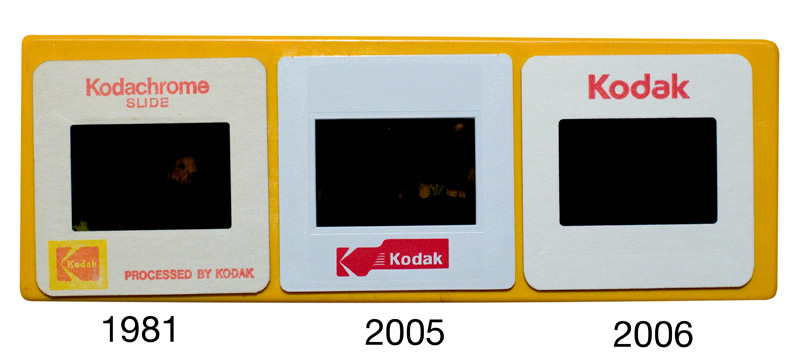
Kodachrome, ah yes that wonderful historic slide film! The first roll I used was about 25 years ago, it came back after two weeks in rounded corner card mounts, later in the 1980's they replaced them with plastic, OK but not as tactile.
Last week I received the first film back from the USA (previously Switzerland) and they seem to have gone retro!
Early comparisons with European processed Kodachrome are favourable, with a slightly cooler colour palette overall, this is only the first roll though, but so far I'm happy.

All text and images © Mark Antony Smith

Wednesday, September 13, 2006

Kodachrome


This film has been around since the mid 1930's and for me defines colour photography in the 20th Century.
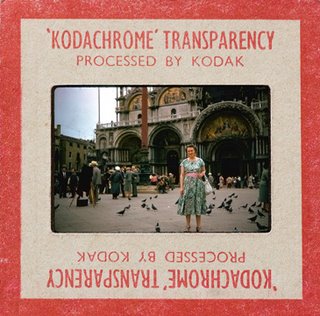
The image above was taken in the 1950's and is over 50 years old, but still it looks as fresh as the day it was made. No other colour film has the archival qualities of Kodachrome and I believe that also extends to the realm of the digital image.

I came across the slide above in a local second-hand camera shop and have no idea who the lady is in picture, just that this is part of a Italian holiday she and her husband enjoyed before I was born!
The films speed at the time was around 10 ASA (compared to 64 today) so anything but good lighting conditions was a challenge.

Why do I still use this antiquated product?
Simple- it gives good colours, fine grain and has a high sharpness. Other films also posses these qualities but none has the longevity. The slides I take of my children today will be easily accessible long after my death by simply holding them up to the light (try that with a DVD). I doubt a fraction of my digital images will survive, I know for sure I've lost one or two from as little as seven years ago due to CD failure.
So I'm preserving the family memories in the best possible way:-
A Leica loaded with Kodachrome

Kids on beach 2006
Long live Kodachrome!